Heated Rivalry, Fatphobia, and Who Gets to Be Desired
What the Heated Rivalry casting decision reveals about representation, fatphobia, and who gets to be the romantic lead.
TW: mentions of bullying, ED and suicide
There’s been a lot of discussion lately about the decision to cast a thin actor as Harris for Season 2 of Heated Rivalry — a character who was originally written as a stocky, bigger-bodied man.
And I want to be really clear about something from the beginning.
This isn’t about attacking Justice Smith — he answered a casting call and EARNED his part. And it is most definitely NOT a criticism of the decision to cast a Black man as a fictional character who was originally white.
We understand how adaptations work and that they aren’t always going to be a perfect one to one representation of the storyline and characters as written in the source material. Casting a shorter than book accurate Ilya or casting an older brunette to play Scott? Fine. People can have opinions about those creative changes, but ultimately, those differences don’t have an impact on the characterization or representation those characters provide.
But changing or removing a marginalized identity is a different conversation.
The Problem Isn’t Just the Casting
You can’t swap out marginalized identities the way you might swap out hair color or change someone’s height slightly and then either dismiss or fail to acknowledge when people are hurt by it.
To date, there hasn’t been meaningful body-positive representation in Heated Rivalry, and that’s particularly frustrating when you consider the opportunity the books gave the show to do something we rarely see: a bigger-bodied person being desirable. Not the comic relief. Not the funny best friend. Not someone whose entire storyline revolves around losing weight or getting rejected until they magically become conventionally attractive.
The media has played the biggest role in perpetuating fatphobia and it gets ingrained in our culture and belief systems from an early age. There has been no end to the amount of characters and storylines that have pushed fatphobia — whether overtly or covertly.
I grew up watching shows like One Tree Hill where they would casually throw in jabs between two very thin characters — Brooke and Peyton — where “fat” was used as the height of insults. They even had an entire storyline with the character Rachel that centered on how “hot” she was and how embarrassing it was that she used to be overweight. It was treated like being fat was quite literally the worst thing someone could be — and in the big year of 2026 nothing has changed.
Harris was a man in a bigger body who was still a love interest. And not just any love interest. He was paired with a conventionally attractive, masculine-presenting professional athlete.
That matters.
It matters because fat people have never been shown as loved, wanted and worthy of being the object of desire. We don’t get to be seen as fully human and often get reduced to stereotypes or a marker that others use as a point of comparison to feel better about themselves.
Being portrayed as a fully realized person with the same value and right to belong is something fat people rarely — if ever — get to see.
Before this casting announcement was made there were already jokes going around about the Heated Rivalry casting process probably having a “no uggos, no fatties” requirement because the main cast are all conventionally attractive, muscular or thin. Now, whether those comments were intended as jokes or not, I think they’re worth examining as they contribute to a larger cultural message that we’ve heard forever:
Certain bodies simply don’t belong in romantic stories unless we’re laughing at them.
And that’s a problem.
Fatphobia Is Still Discrimination
I think one reason this conversation gets so uncomfortable is that we’ve gotten much better at recognizing certain forms of discrimination. We’re increasingly willing to talk about racism. We’re more willing to talk about homophobia. We’re having conversations about disability, gender, and LGBTQIA+ representation. But fatphobia? We still treat it like it’s somehow exempt.
Every community — especially marginalized communities — has experienced fatphobia. And that’s part of what makes it so pervasive.
You can be Black and experience racism while also being told your body is unacceptable. You can be queer and experience homophobia while also experiencing intense pressure to look a certain way. You can be disabled and face ableism while also being judged for your weight. You can be a woman, a man, nonbinary, queer, straight, religious, nonreligious, disabled, nondisabled and STILL encounter fatphobia.
And it’s so normalized that we often don’t even recognize it as discrimination. Sometimes fat people don’t recognize it either.
There is an egregious amount of internalized fatphobia. Fat people are taught to blame themselves and then turn around and perpetuate harm by telling other fat people that if they’re unhappy with how they’re treated, they should simply lose weight or stop complaining.
If we want accommodations, we’re asking for too much. If we’re hurt by a joke, we’re too sensitive. If we’re disappointed that a character who was written as fat isn’t fat anymore, we’re being unreasonable. And that’s the exact mentality we need to challenge.
“But It’s Just Casting”
This is where I think some of the criticism gets misunderstood.
Nobody is saying that Justice Smith doesn’t deserve the role. We’re not saying he isn’t talented or that the show has to perfectly reproduce every physical characteristic from the books.
We know that’s not how adaptation works. But there is a difference between changing a character’s appearance and removing something that has social meaning.
If Ilya is a little shorter than he was in the book, that doesn’t fundamentally change the way audiences understand height as a marginalized identity. If Scott is a tall, hot brunette instead of a tall, hot blonde, nobody is losing an opportunity to see themselves represented in a body that is historically excluded from romantic desirability. But when you take a character whose bigger body was an important part of his characterization and make him thin, you’re removing one of the few opportunities for fat viewers to see themselves reflected in that kind of role.
That’s not just a cosmetic change and bringing this point up doesn’t mean the creators are evil or illintended . It means creative decisions can have consequences.
Those two things can exist at the same time.
The Bigger Problem: The Lack of Acknowledgment
This is where the situation becomes even more frustrating: the issue isn’t only what happened, it’s how the disappointment has been handled afterward.
Rachel Reid recently posted an Instagram story in response to some of the criticism, and many fans — myself included — felt that the wording came across as smug and dismissive.
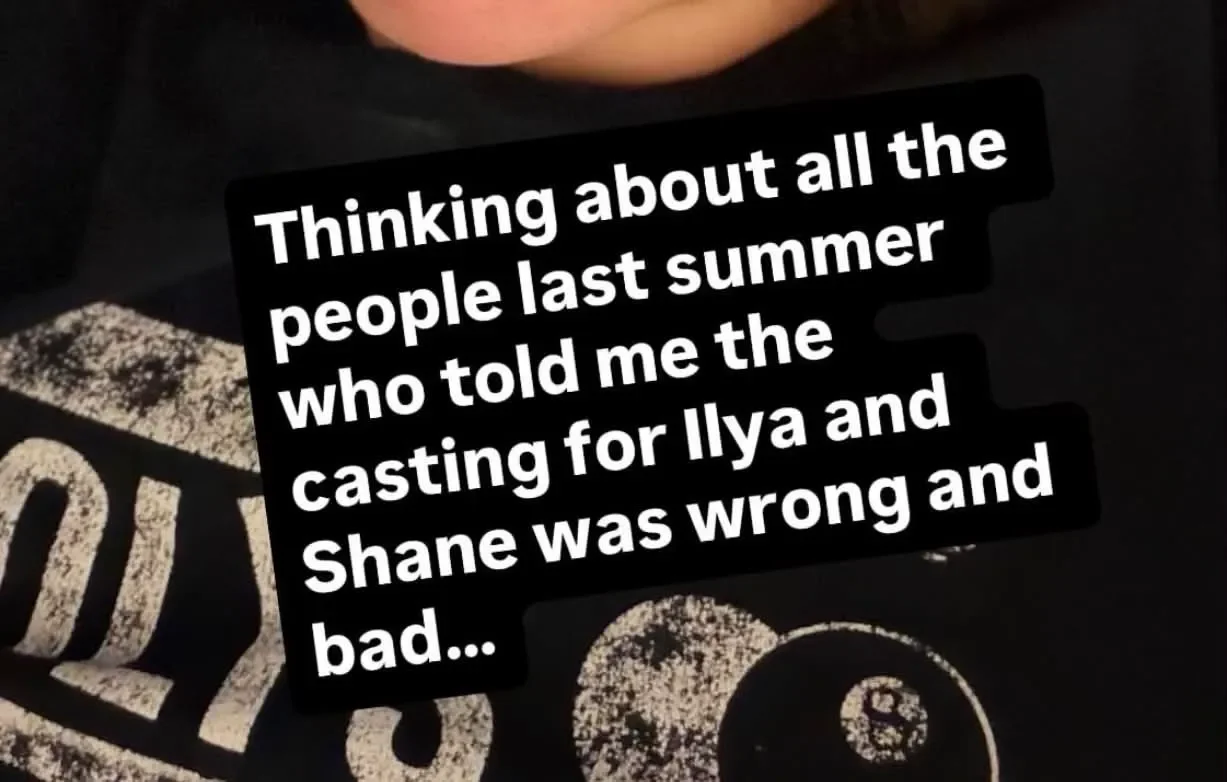
Screenshot from Rachel Reid’s Instagram story. Text reads: “Thinking about all the people last summer who told me the casting for Ilya and Shane was wrong and bad…”
Jacob Tierney also hasn’t publicly addressed this particular issue in a meaningful way. People who were genuinely excited to finally see this kind of representation are left feeling like their disappointment doesn’t matter.
This is especially frustrating when there has already been criticism surrounding how concerns and recent pushback have been addressed…or not addressed.
For example, fans have also pointed out the lack of public acknowledgment or condemnation surrounding racist attacks directed toward Hudson Williams.
I’m not bringing that up to conflate racism and fatphobia. They’re different forms of discrimination. I’m bringing it up because patterns of silence matter.
When marginalized fans repeatedly see concerns go unacknowledged, it becomes harder to trust that the people behind this hugely successful project understand what those concerns actually mean or even care. And that matters even more when the show is dealing with other marginalized identities.
“But Rachel Is Queer.” “Jacob Is Gay.”
I’ve also seen versions of this argument:
“Rachel is queer. Jacob is gay.”
“They cast trans actors and made Harris Black for more racial diversity.”
“How can you accuse them of perpetuating discrimination?”
Well…this is where intersectionality enters the chat.
Being marginalized in one way does not automatically make someone incapable of perpetuating harm against another marginalized group.
Jacob is gay. He is also a white man. Rachel is queer, a woman, and disabled. She is also white.
Those identities don’t cancel each other out and whiteness provides privileges and blind spots even when someone has other marginalized identities. That’s not an accusation of malicious intent. It’s an acknowledgment that none of us exist outside of culture.
We absorb the assumptions of the societies we grow up in and one of those assumptions is that thin bodies are more desirable, the default, that fat people should be grateful for whatever representation they get, and that criticism from fat people can simply be dismissed as complaining. Those ideas don’t disappear because someone is also queer, gay, disabled, or part of another marginalized community. If anything, understanding intersectionality should make us more capable of recognizing that.
Success Doesn’t Make You Above Criticism
There’s another element here that I think is worth talking about.
Heated Rivalry has become enormously successful. The show has received many awards, the cast has become international superstars, and the creators have received a tremendous amount of attention. That’s awesome!
Seriously.
I want this show to succeed.
I want queer stories to succeed.
I want the actors to succeed.
I want the creators to succeed.
But success can create a weird dynamic where criticism starts getting interpreted as people simply being ungrateful. It comes across as:
“We made the show. We know what we’re doing. It’s successful. So why are you complaining?”
But the audience isn’t separate from that success.
The people who bought the books, recommended them, streamed the show, talked about it online, created fan art, and brought new viewers into the fandom — those people helped create the cultural phenomenon Heated Rivalry has become.
And fans are allowed to love something while also being disappointed by it. Those aren’t contradictory positions. You don’t have to hate a show to criticize it. Hell, sometimes criticism comes because you care.
Why This One Hurts Personally
Alright, so I’m going to get a little personal here.
I have a very intersectional identity: I’m fat. I’m Black. I’m queer. I’m disabled. I’m neurodivergent. And I’m a woman.
I have spent most of my life consuming media where I might see one or two pieces of myself reflected but never the whole picture. That’s something people who don’t experience multiple marginalized identities may not always understand.
Representation for me has always been fragmented.
I’ll see a character who may be Black and queer, or a character who is physically disabled or neurodivergent. But it’s incredibly rare to see someone who exists at the intersection of multiple marginalized identities, period. And if they are showcased, they’re never allowed to simply exist without their identity becoming the entire point of the character.
Being overweight my entire life, I’ve experienced bullying, including physical threats of violence, and I struggled with an eating disorder as early as 11 years old.
An experience that’s burned in my brain occurred one afternoon when I was walking home from school alone. Three girls I wasn’t familiar with — but somehow they knew my name — approached me initially under a friendly pretense. After I acknowledged them one girl’s face turned cold and she said, verbatim: “I should bust you in your fucking face for being so fucking fat.” They then proceeded to chase me for a few blocks as I ran home for dear life in tears.
I didn’t do anything to them — I didn’t even know them. Me just existing as I was apparently gave them permission to threaten me with violence.
I remember being in 6th grade and it was the first time I realized boys weren’t icky cootie carriers. I started to exercise heavily and stopped eating when it wouldn’t be noticed by anyone because I had already internalized at that young age that if I wanted the boy I liked to like me back, I had to be thin.
That same year during the summer between 6th and 7th grade I ended up having to have hip surgery on both hips that put me in a wheelchair for several months and permanently altered my mobility. During the time I was relearning to walk I went from chubby to obese. I entered a deep depression and at the age of 12 had my first suicidal ideations. I genuinely thought there was no point in being here anymore if I was fat and disabled. Everything I’d ever seen and heard only reinforced that very incorrect assumption, but it was all I knew at the time.
I share this because I now know that having positive representation in the media would have gone a long way in helping 12 year old me to understand that I have inherent value — that I didn’t have to look a certain way or function a certain way in order to be worthy of life and happiness.
And that’s why this conversation isn’t abstract for me. When you’re taught from childhood that your body is something that makes you less desirable, less worthy, less acceptable, seeing someone who looks like you finally get to be the bad bitch — the romantic lead, the one that the main character chases, can mean so much. It’s more than entertainment — it’s a tiny correction to years of messaging that told you otherwise.
What We’re Actually Asking For
So what would I like to see happen? Something incredibly simple. Acknowledgment.
That’s it.
Jacob and his team don’t have to agree with every criticism. We’re not asking them to change the casting or apologize for making a creative decision. But what they can say is: “We understand why people were disappointed and we hope you can still trust us to bring you an impactful and heartfelt story once again.”
That’s not admitting that you’re terrible people. It’s recognizing that something you created — and the decisions you made — had an impact on people that you may not have anticipated. And frankly, that kind of acknowledgment could go a long way toward rebuilding trust.
Fat people are so accustomed to being told that our disappointment doesn’t matter: that we’re asking for too much, or we’re too sensitive, or we’re lucky to be included at all. So when we finally get excited about the possibility of seeing someone in a bigger body portrayed as desirable — and that representation disappears — we’re allowed to be disappointed. We don’t have to pretend we’re not.
And ultimately, that’s my point.
You can’t treat marginalized identities like they’re interchangeable. You can’t swap them out the way you would change someone’s hair color and then expect people not to notice. And you certainly can’t ask marginalized audiences to celebrate diversity while ignoring the forms of diversity that make you uncomfortable.
Heated Rivalry had an opportunity to give fat viewers something we rarely get: a bigger-bodied person who is wanted, loved, sexy, and who gets their love interest without having to jump through hoops or change who they are.
If people are disappointed that opportunity appears to have been lost, I don’t think the appropriate response is to tell them they’re wrong for feeling that way or make light of their disappointment.
The bare minimum is to acknowledge why it mattered.
If we genuinely believe that diversity and representation are important, then we have to care about all of it. Not just the identities we’re most comfortable talking about. And sometimes doing better doesn’t require a grand apology. It doesn’t require a complete overhaul. Sometimes it starts with simply saying: “We hear you. And we understand why this hurts.”
That’s not asking for too much.